
🤯 I Was Wrong About Voting
Why I finally changed my mind. ⭐

I left legacy media to build something different: independent, honest political analysis with no corporate or partisan agenda.
I call balls and strikes ⚾ — because politics needs referees, not cheerleaders.
If you want clear, concise analysis that cuts through the noise, subscribe today. You’ll get what actually matters—not just what people want you to hear. 🎯
Some news:
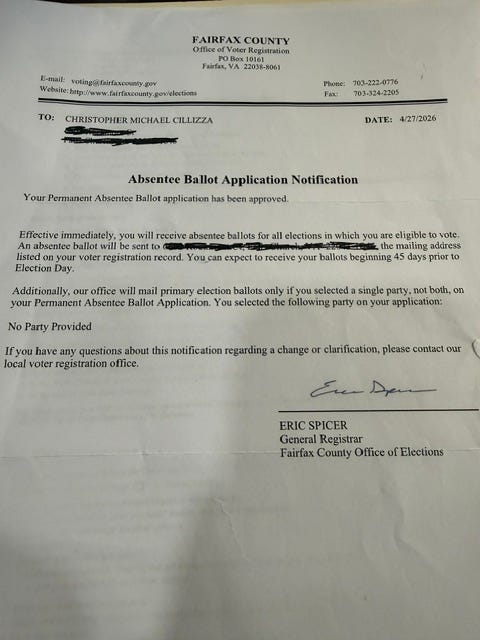
I am now — for the first time in my life! — a registered voter.
I am a permanent absentee ballot voter in the Commonwealth of Virginia (at least until Donald Trump outlaws it!). I am registered as a “no party preference” voter.
As you can tell from the letter above, I did all of this a few months back. But I have been thinking about the best way to write about it since then.
Why? Because my past pieces about not voting have provoked some — how to say it — strong reactions from the “So What” community!
Given that, I wanted to make sure I had all my ducks in a row about all of this before writing about it.
Here’s the short version: I realized I was wrong.
This post is FREE. But practicing actual independent journalism isn’t free! Please consider becoming a paid subscriber to “So What” today. You can read more about what you get from a subscription — and what you are supporting — here.
I tell people ALL the time that the political world isn’t black and white. It’s shades of grey. And that anyone who tells you things are black and white is usually just not thinking deeply or seriously.
And yet, my stance on voting — I can’t do it because I don’t want anyone to think I am biased — was totally black and white. All or nothing. Throw the baby out with the bathwater.
Choose your idiom. The point is this: I was so fixated on not appearing biased that I never considered two very nuances of voting:
I am not obligated to vote for EVERY race on the ballot
I am not obligated to share publicly who I voted for in every race
I want to dig deeper on both of those points in a minute. But I don’t want to go any further into the post without crediting YOU ALL for your thoughtful comments (and critiques) on all of this. YOU helped me get me to what I think is the right place on all of this. I am grateful.
Ok, now to the nuances!
I am not obligated to vote for EVERY race on the ballot
My mentality is that I wanted to be as objective as possible about the races I am regularly reporting on and writing about — and therefore didn’t want to cast a ballot one way or the other.
But the truth is that there are a whole lot of races (and ballot initiatives, propositions etc.) on the ballot in Virginia that I DON’T cover. That I never write about. That could very well impact my daily/weekly/monthly/yearly life as well as that of my wife and my boys.
Why shouldn’t I vote on those? I’m a citizen, after all! I asked myself that question. And I found I had no good answer.
Which brings me to the presidential race, governor’s race and Senate races.
I will be totally transparent with you all: I haven’t made up my mind whether to vote on those.
By registered to vote, what I did was ensure I had the choice on whether or not to vote on the top-of-the-ballot races. I didn’t want to leave registering to the last minute and then not do it at all. (Trust me, I have done that before.)
Let me be clear: If I DO decide to vote for president, governor and Senate — and I am leaning toward doing it — that does NOT mean that I am a Republican or a Democrat. It means that at the moment I am voting — and based on everything I know about the two candidates, their temperaments, their policy positions, their voting records etc. — I think one would do a better job, at that particular moment, dealing with the problems facing the Commonwealth or the country.
I am now — and have always considered myself to be — a political independent. Again, in the interest of transparency: I am not a big fan of either party. I don’t think either the Democrats or Republicans are doing a very good job right now. (Judging by the approval numbers for thew two parties, I am far from alone.) Given that, I think it’s uniquely possible that I vote for one party’s candidate for president in 2028 and the other party’s candidate for Senate. I am a true swing voter!
I am not obligated to share publicly who I voted for in every race
This is the point SO many of you made to me the last time I wrote about not voting in April.
I (Still) Don’t Vote. Here’s Why. 🗳️🤯

The easiest way to win in media today is simple: pick a side and tell your audience what it wants to hear. 🔥
really liked how Tom Bernardo — a paid “So What” subscriber!! — put it in the comments section of that post:
If you call the balls and strikes genuinely then the next step is to vote confidently and privately. It’s simply your and my responsibility as a citizen in a republic.
I wrestled with that comment for a long time — looking for holes in Tom’s argument.
I couldn’t find any.
The simple fact is that voting is a private thing. Hell, my own dad would NEVER tell me who he voted for! (Sidebar: That annoyed me to no end as a kid and a young adult. But now I get it!)
I am more of a public figure than my dad was. And, as a political reporter, there is a HUGE amount of interest in who you vote for (or if you don’t vote).
I get it. Especially when you consider the data that suggests that the majority of reporters are registered Democrats:

And I have, throughout my career, tried to be as up front and honest about what I do and how I do it as I possibly can be.
The reason is simple: In a world where almost no one trusts reporters, I wanted to let people in as much as possible — so that they could see that any mistakes I made or biases they thought I had were the result of honest errors, not some secret plan to elect Republicans or Democrats.


I still very much believe in that open-doors philosophy. I think transparency is the way back to trust. I am not doing anything nefarious. The more people can see that, the better chance I have in people believing I really am trying to be an honest broker amid this sea of partisan hacks.
But, I also did some reading on the history of the secret ballot in the United States. Fun fact: We did not always have secret ballots!
This explainer, from the Congressional Research Service, is useful on the subject:
Voting in the United States used to be a public process. Voters in early American elections often indicated their preferences by verbally announcing them, for example, or raising their hands.
Methods like voice voting had largely been replaced by written ballots by the middle of the 19th century, but those ballots did not necessarily offer significantly more privacy. Although voters could supply their own ballot, a more common approach was to use a political party-provided ticket. Parties’ tickets were typically readily distinguishable from each other, such as by color, and handed to election officials in public view.
The lack of privacy enabled efforts to influence voters’ choices. It made it easier for individuals engaged in vote buying to confirm that voters marked their ballots as arranged, for example, and harder for voters to shield their selections from people who might try to coerce or intimidate them into changing them.
We adopted the secret ballot to STAVE OFF pressure campaigns and vote buying!
And yet, I found myself worried about what people would say about me if I didn’t make my ballot public. Which was me giving in to a pressure campaign!
So, no, I am not going to be sharing who I vote for in future elections. And I no longer feel bad about it.
RESOLVED: Michael Kinsley is always right
Regular readers know I am a BIG fan of the columnist and essayist Michael Kinsley.
I included a quote from Kinsley about reporters voting (or not) in the April piece I wrote about why I didn’t vote.
And it just kept eating away at me over the ensuing months.
This notion that journalists ought to be sort of political, ideological eunuchs who don't have any political views is just hopeless. The question isn't whether they hold opinions but whether they suppress those opinions to the extent they can when they do their work.
It’s that second sentence — “The question isn’t whether they hold opinions but whether they suppress those opinions to the extent they can when they do their work” — that I kept coming back to.
I am a human. I have thoughts and opinions — on policy, personalities and politics. To pretend otherwise is laughable. (Sidebar: I really am not some secret partisan, however. My views are very rarely in line with a single party or even tribe.)
The question, as Kinsley so eloquently wrote, is whether I can put those personal views aside — and you can trust me to put those views aside — when I write ands talk about politics.
As proof I can, I offer up the work I have done over these past three and a half years on this Substack and my YouTube channel. And the work I did in the 20+ years I worked in mainstream media.
Thanks, as always, for reading. And for your thoughtful comments on this subject — and all the rest too!
Just wanted to say thanks to everyone for the thoughts on this. MUCH appreciated.
Voting is a privilege and a duty of citizenship. We need not explain whom or what we vote for, but it is critical to do it. Good move, Chris!